HRV Ride
A designer building an app for an audience of one: myself. A product is never finished. Every ride that breaks down is a bug report.
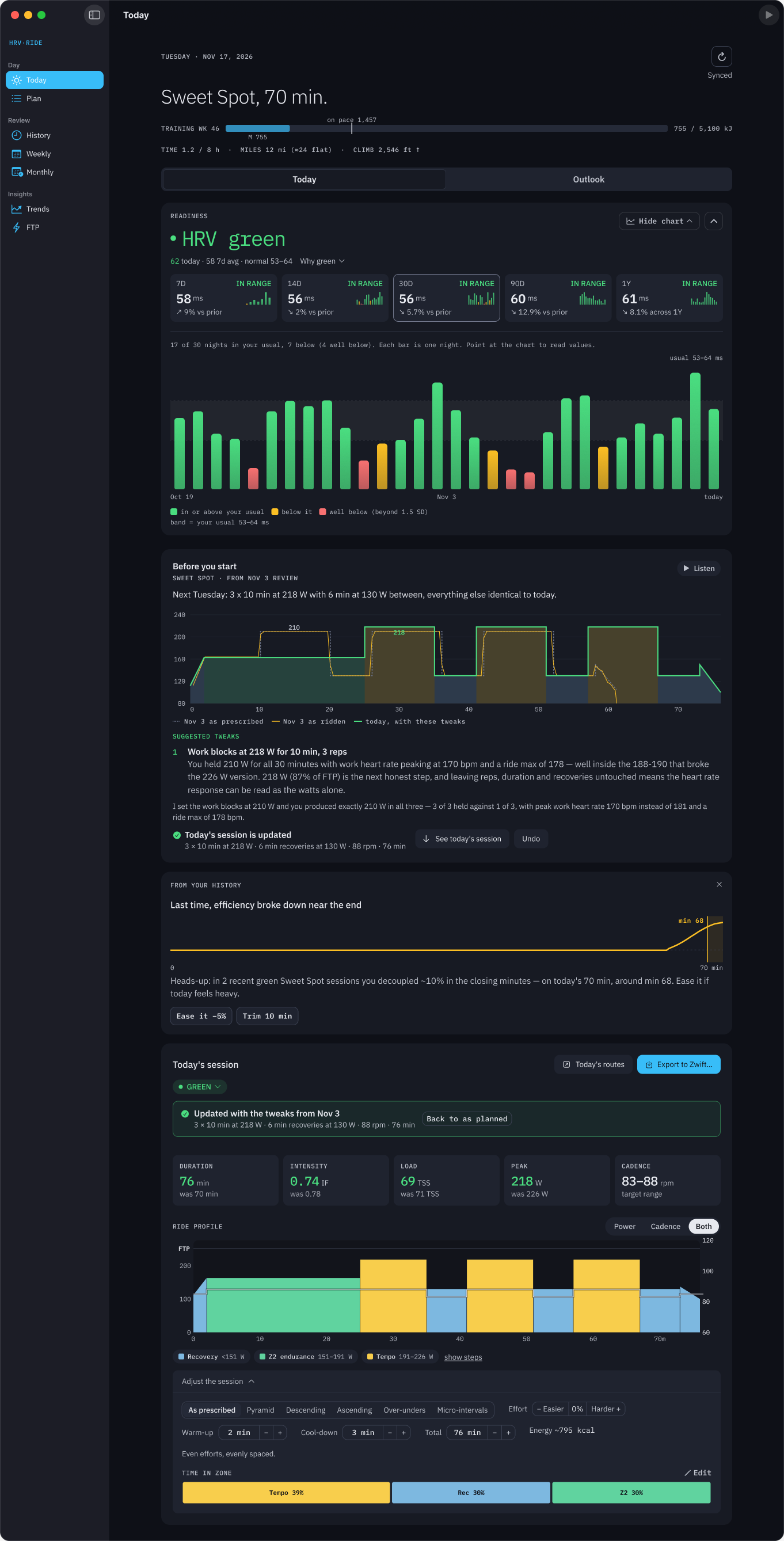
HRV Ride · A designer building an app for an audience of one: myself
The app is the product, I'm the only user, and every ride is a round of user testing. When a ride breaks down, I trace what the AI logic missed and fix it. The rules evolve, and they need fixing less and less.
A tool for my week
The whole point of HRV Ride is to help me improve my HRV and my FTP.
It started with a time problem. I was using Claude to give me a set of weekly routes, then building each one by hand in Zwift. That took upwards of 90 minutes, and the workouts didn't take my HRV into account. Building a route in Zwift's UI is slow when there are a lot of over-unders or blocks at different watts and cadences. A basic, blocky workout takes 5 to 10 minutes, and considerably more when there are lots of changing elements. If I had to keep doing that, the whole idea wouldn't be sustainable for my sanity or my time.
So I built HRV Ride with Claude Code. The first version was simple: a UI that kept track of my week ahead and created the workouts to upload to Zwift. This was one of the few apps I designed primarily for the Mac instead of my iPhone, because the Zwift file has to go through my computer.
Now, once I know my ride, HRV Ride creates the custom route for me. I download the Zwift file and import it into my Zwift account.
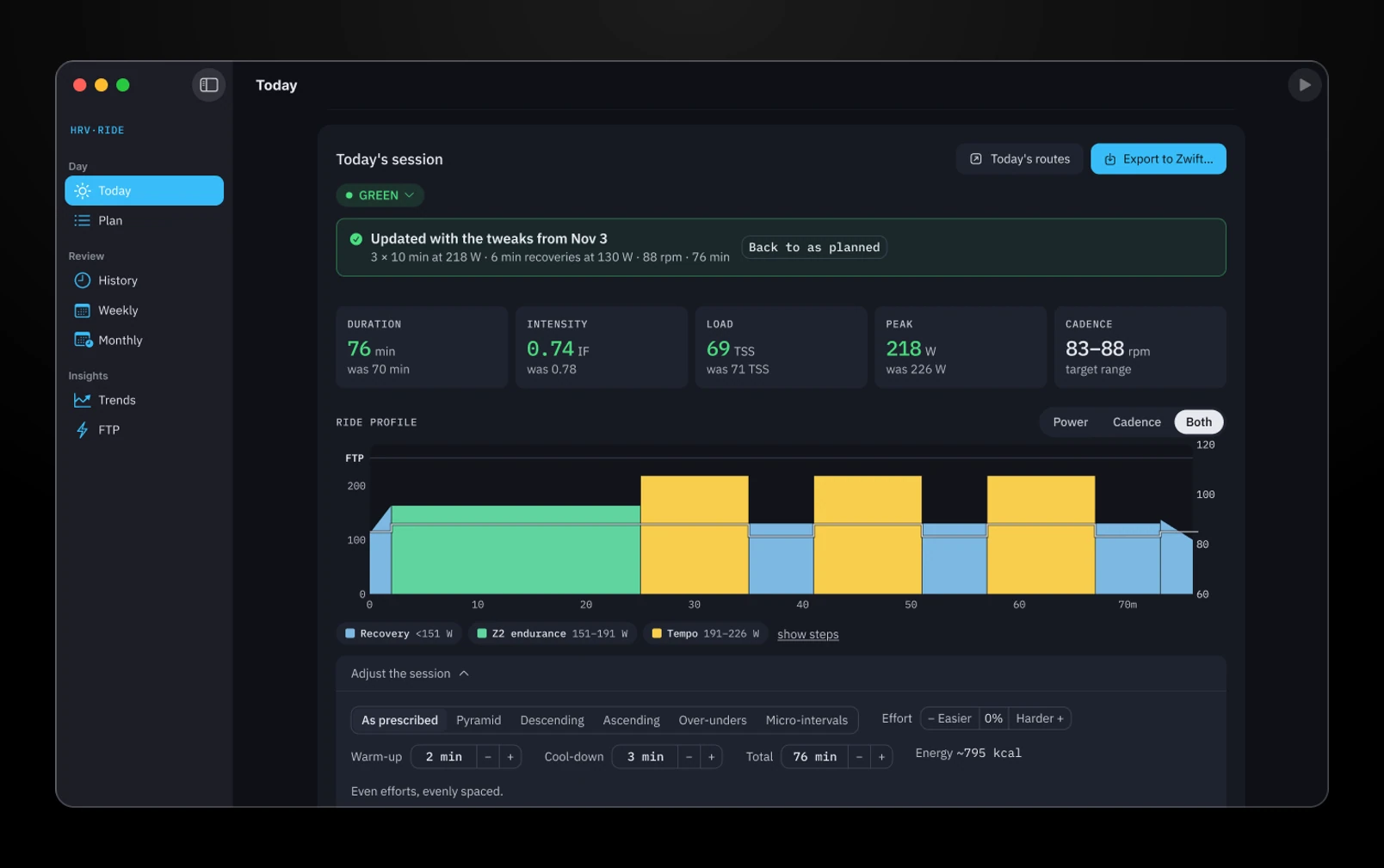
The first plan was simple too. My HRV score picked a hard, medium or easy ride, and the hard days rotated through RUTT intervals every four weeks.
Every morning, a new iteration
Over time, the app evolved from a weekly tracker into something that read my HRV data and made the workouts dynamic. That in turn had me adjusting the UI almost every morning, for weeks on end. Each morning I made a couple of tweaks to the UI or the flow. Most were small iterations and experiments: adding and removing data, graphing the workout, making the workout easier to tweak, and tuning how the AI recommends it. All of that shaped what the UI shows from the data and the analysis.
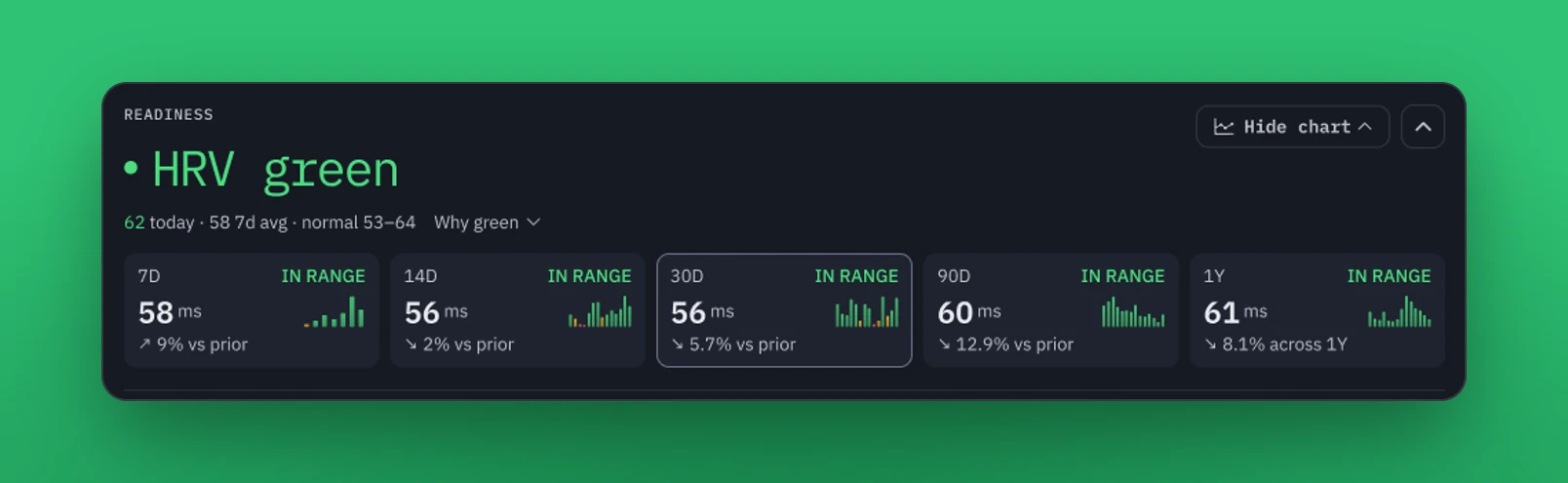
The red, amber and green (RAG) score was one of the key design decisions. It's an easy way to keep track of where my fitness is at, though I can see the colors evolving over time. Green means my fitness is in optimal shape, so the workout is going to be quite challenging. Amber is about maintaining my current fitness without burning my engine. Red means my engine needs a real slowdown to recover.
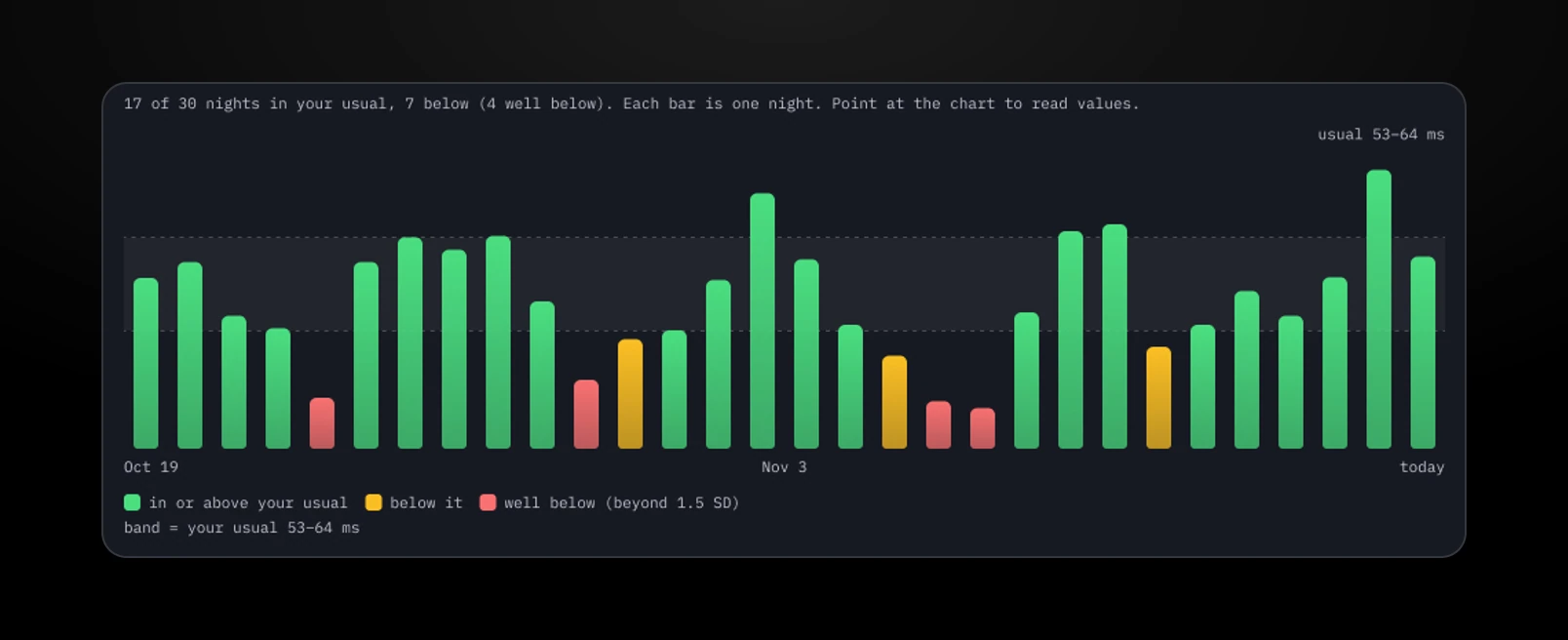
The score comes from data HRV Ride pulls in from Apple and Whoop. The workout is then determined by the score and by what I'd typically do on that specific day. Each day of the week is part of a bigger system, and each week is part of a monthly program. So each month is broken down into weeks, each week into days, and each day is shaped by the HRV score. Green is an all-out kind of day, broken into segments that match what my optimum should be. If it's amber or red, the same workout is turned down to match the color.
Once the HRV score comes in, the AI takes it along with what's scheduled for today and tweaks the workout for my body. Its main focus is keeping me from burning out. It evaluates what I did the previous week, and how I did in similar conditions. For example, a green day last week may have called for a workout that was too strong and overworked me. The app knows to break down certain segments this time to keep my exertion at a sustainable level.
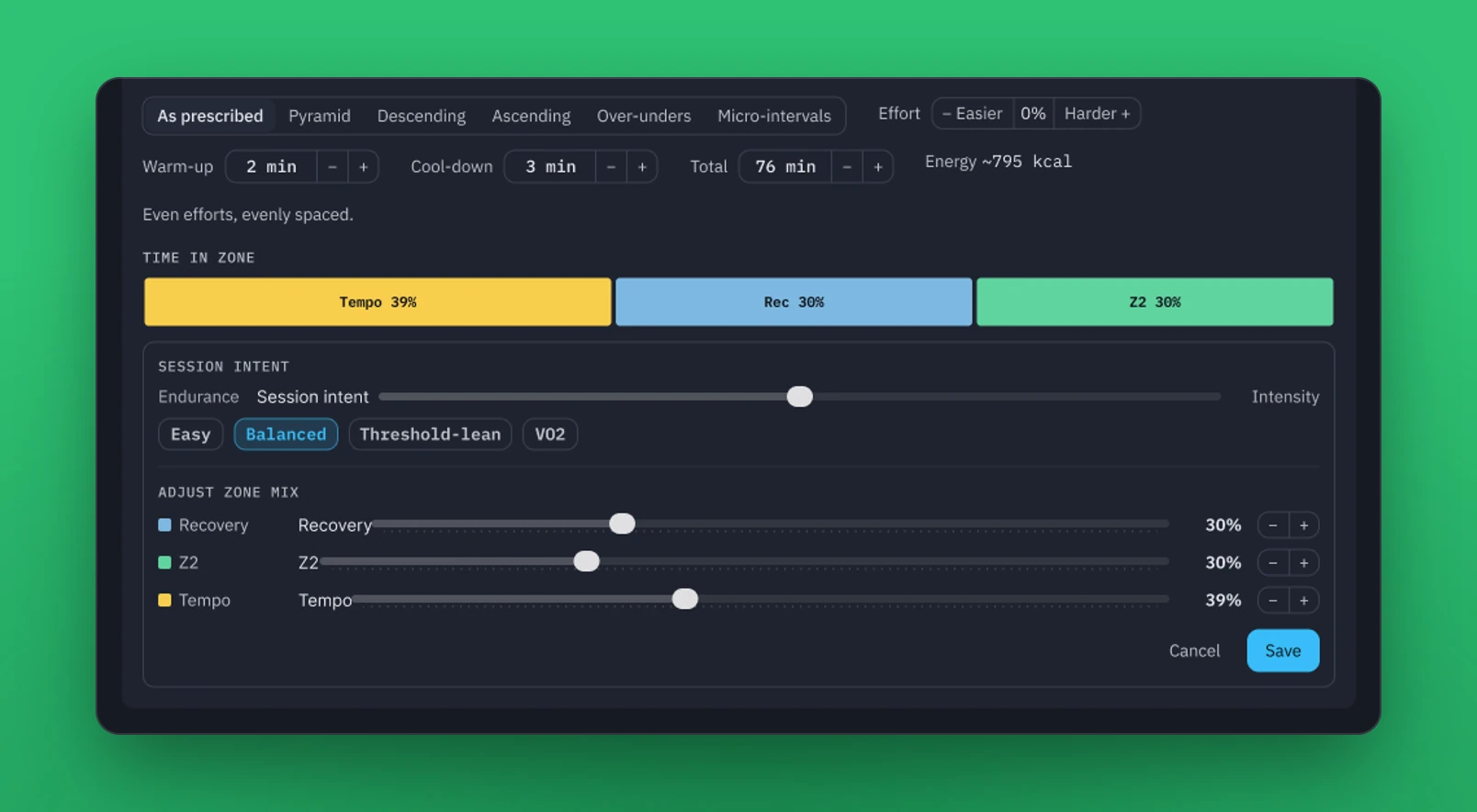
The daily view shows how my HRV is trending across a couple of different time ranges, along with the block workout I should do. It suggests bigger tweaks if my HRV is in the amber or red. I can customize the workout too, whether that's tweaking a single data point or reducing the intensity by 10%.
Each day also fits into a bigger picture, and time is what ties the week together. Weekends are much longer rides, and I need one day for rest and recovery. The other days account for how recovered my body is and what's coming up. Monday used to be my recovery day after the long weekend rides. I recently changed that to build more fitness: now Friday is a lighter recovery ride before the weekend, and Monday is a regular day with an eye on my HRV, which can lighten the load if I really need it.
Testing surfaced problems the first design missed.
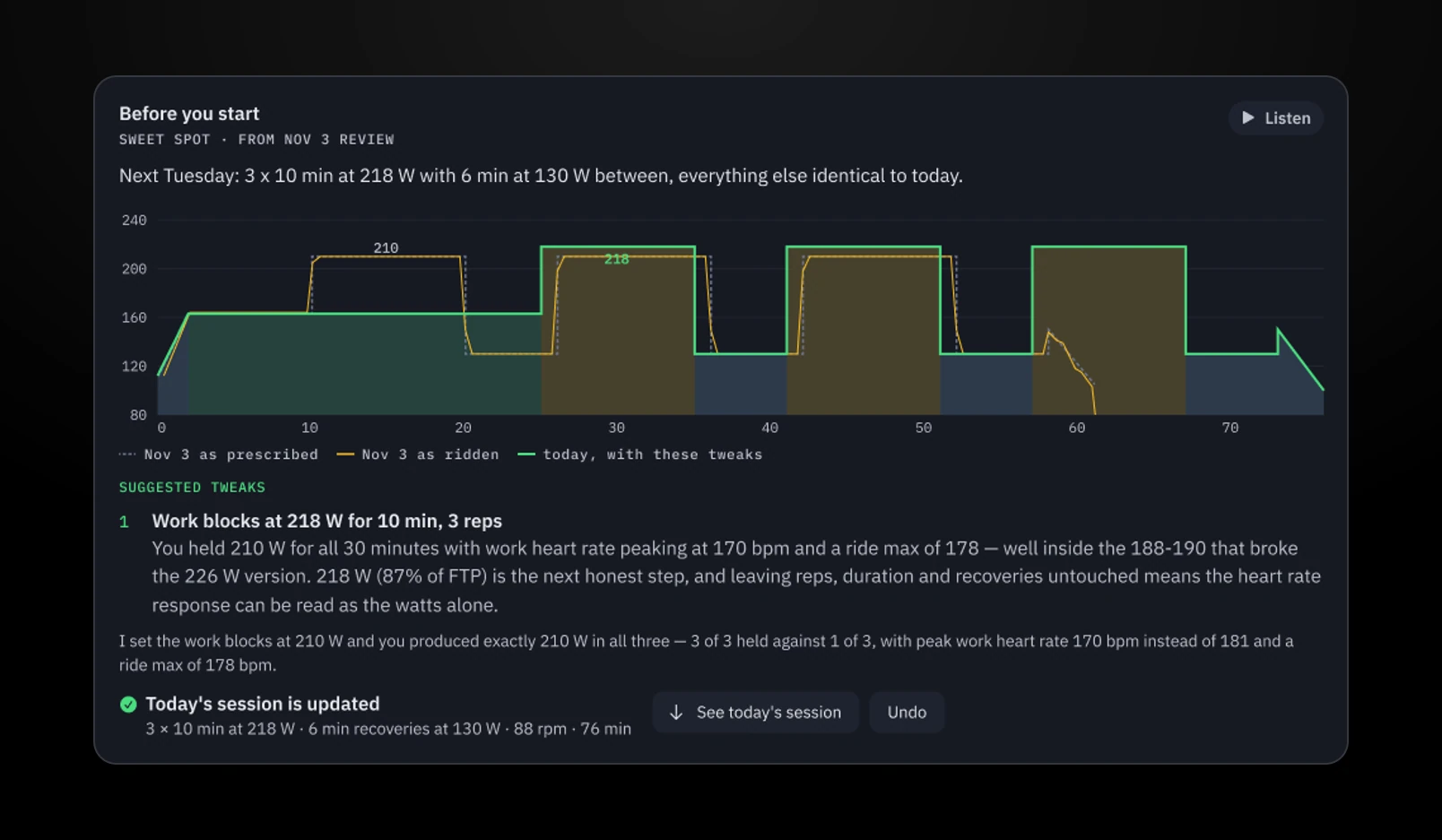
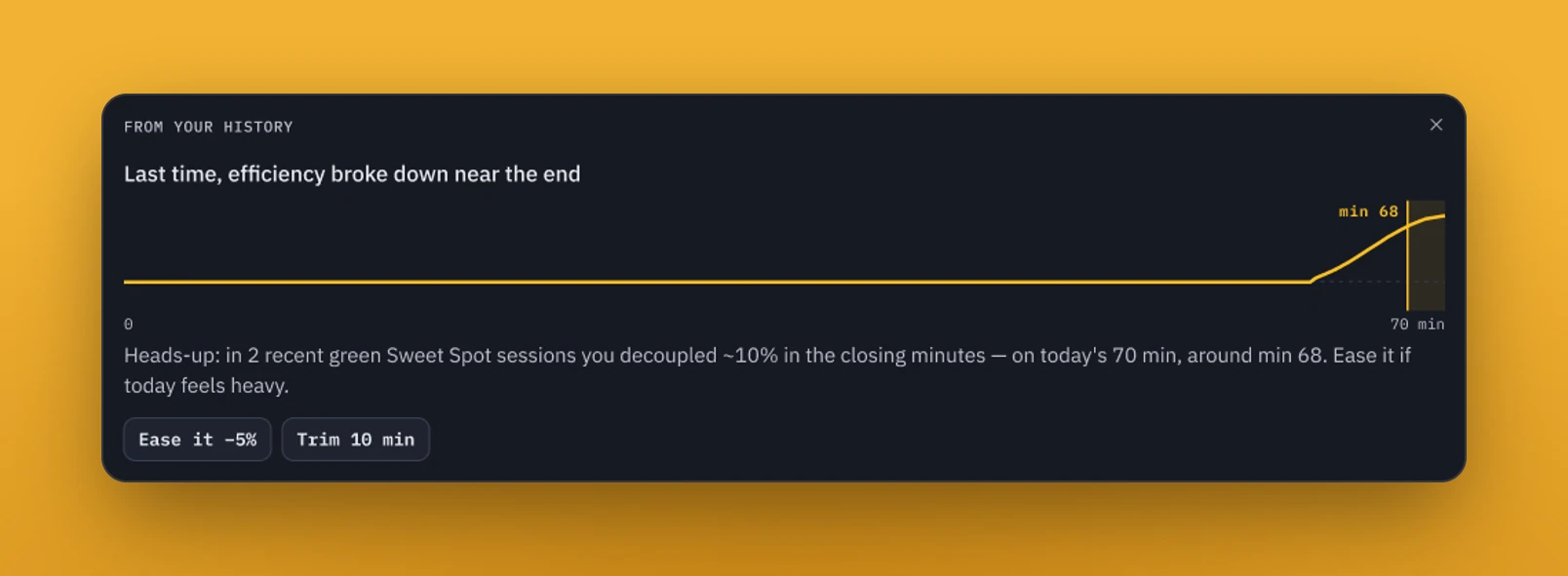
The workouts weren't taking the previous day's recommendation, or how my body reacted to it, into account. Cadence was an issue too: a block might call for zone 2 or 3, but a high cadence was pushing me into zone 3 or 4. So I added rules for both, plus a visual that shows where my workout broke down last time and gives me options to tweak the ride's levels if I think the next one will cause trouble.
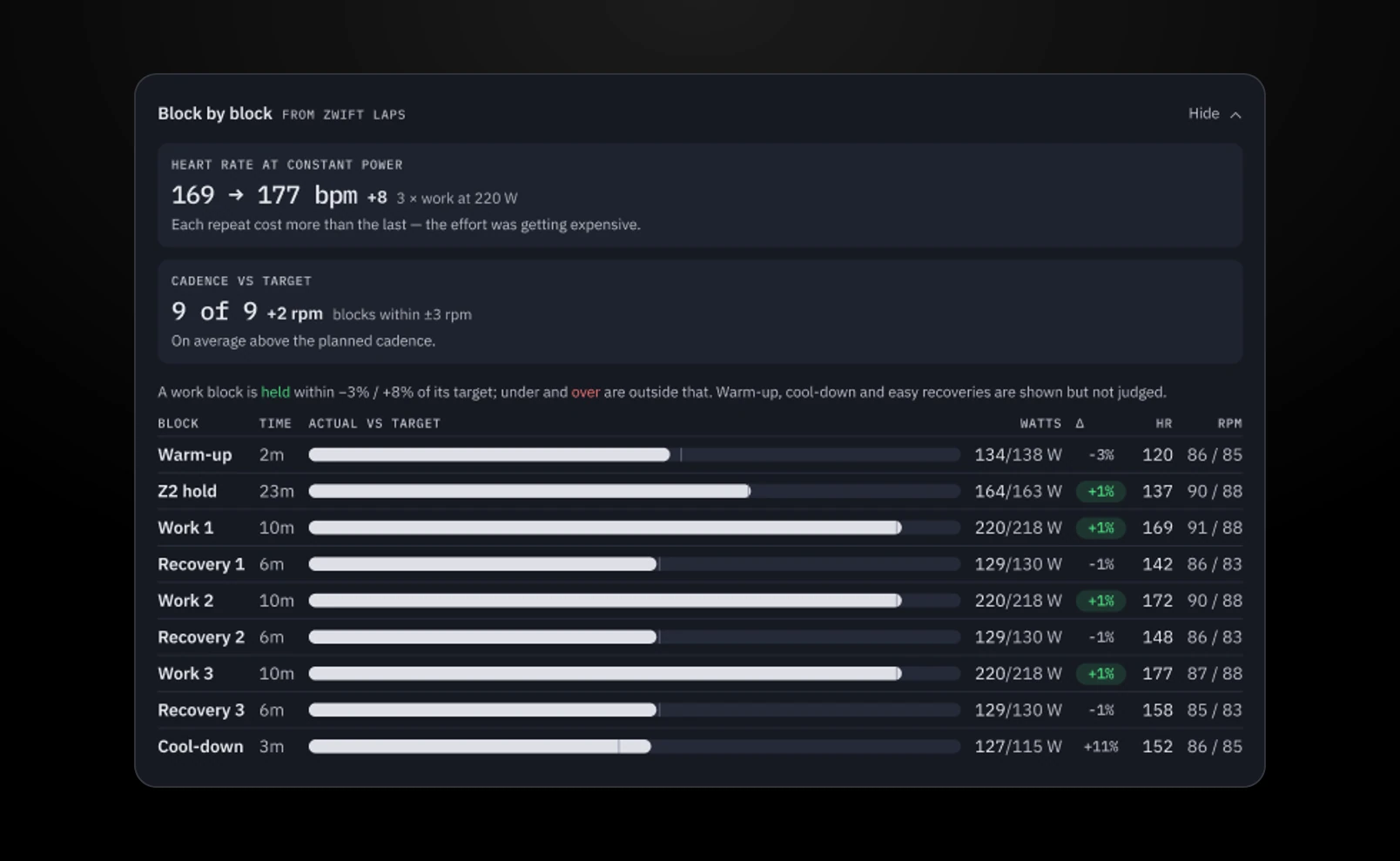
I also had AI analyze my rides to check the plan itself. The first review showed I'd ridden eight straight weeks with no easy week and burned out, so every fourth week became a recovery week. The next review went block by block. I hit the short RUTT efforts six times out of six, but missed 200 watts for five minutes three times out of five. Short, hard efforts were never my problem. Holding power for a long time was.
Every broken ride is a bug report
After a ride, I compare my workout with the original design. When the ride goes as planned, there isn't much to notice. Typically I can ride the full workout without needing to negotiate a slowdown. Holding zone 3 or 4 for the set period is no problem.
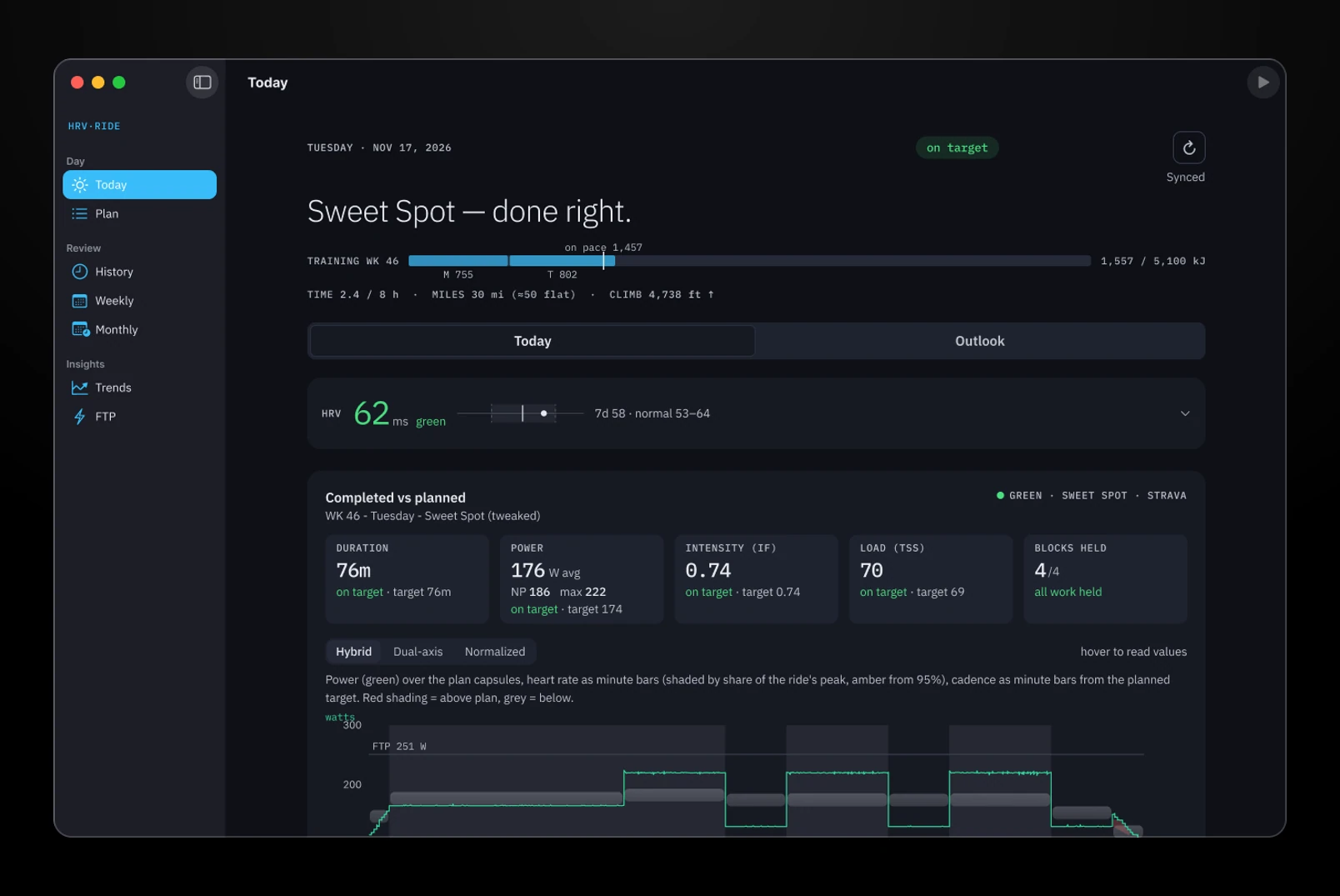
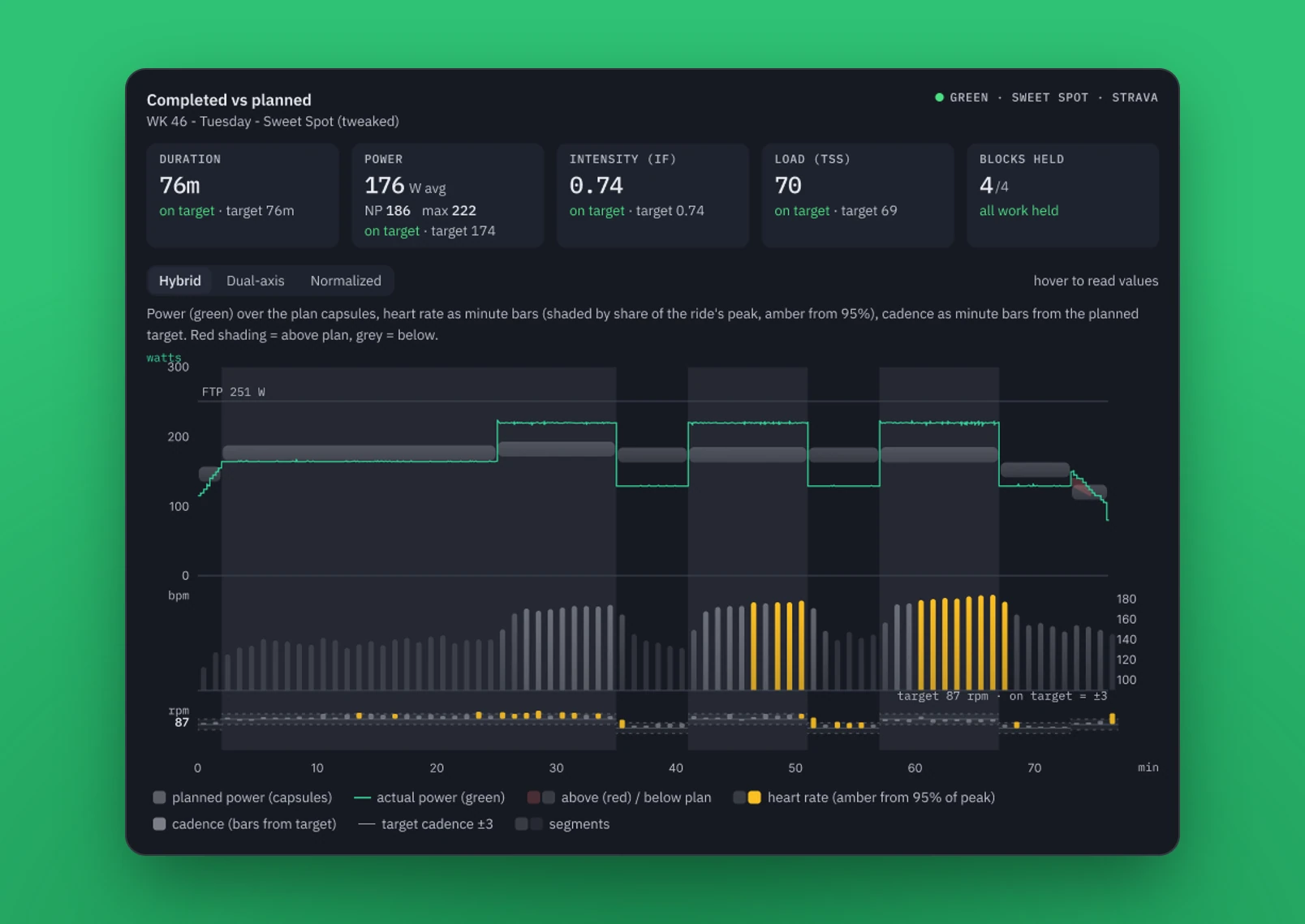
When I have to drop from zone 4 to zone 1 and back just to get my heart rate to a manageable rate, I know something has gone wrong with the workout rules. I'm too consistent with my workouts for my body to crash mid-ride. I really shouldn't get caught out needing a break.
Thankfully those rides are rare, and they're usually green days that really pushed me. When it happens, the AI has usually missed something: aspects of my ride the previous week, a high cadence, or other rules from that day. So I go back into the AI logic, find what was missed and teach it to catch that next time. That's when the rules evolve. As I've done that, I've had to reassess the logic less and less.
Those fixes carry forward. If my body is in a similar state to the last time a ride went wrong, the app can tell me ahead of time to take time or effort off.
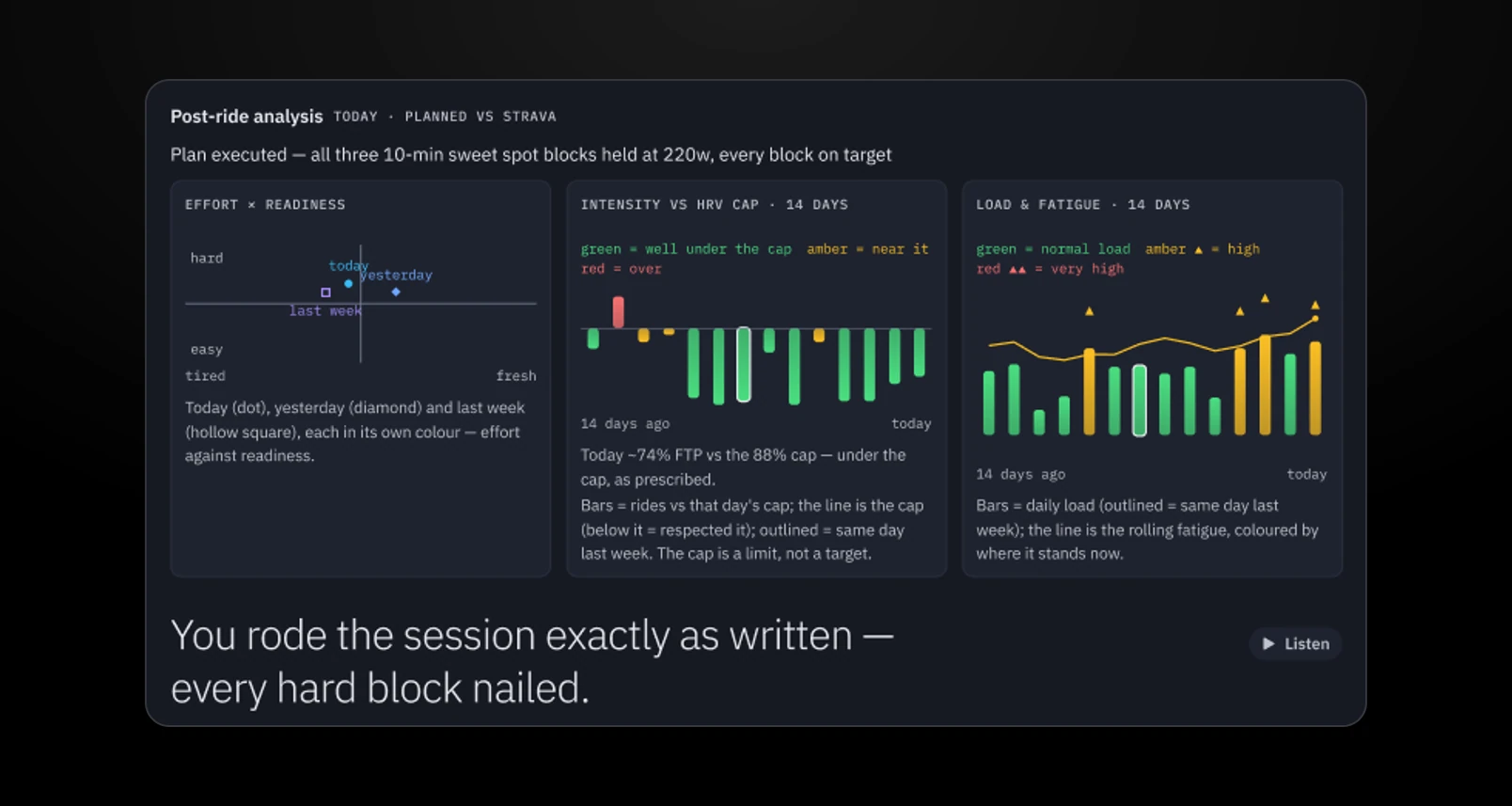
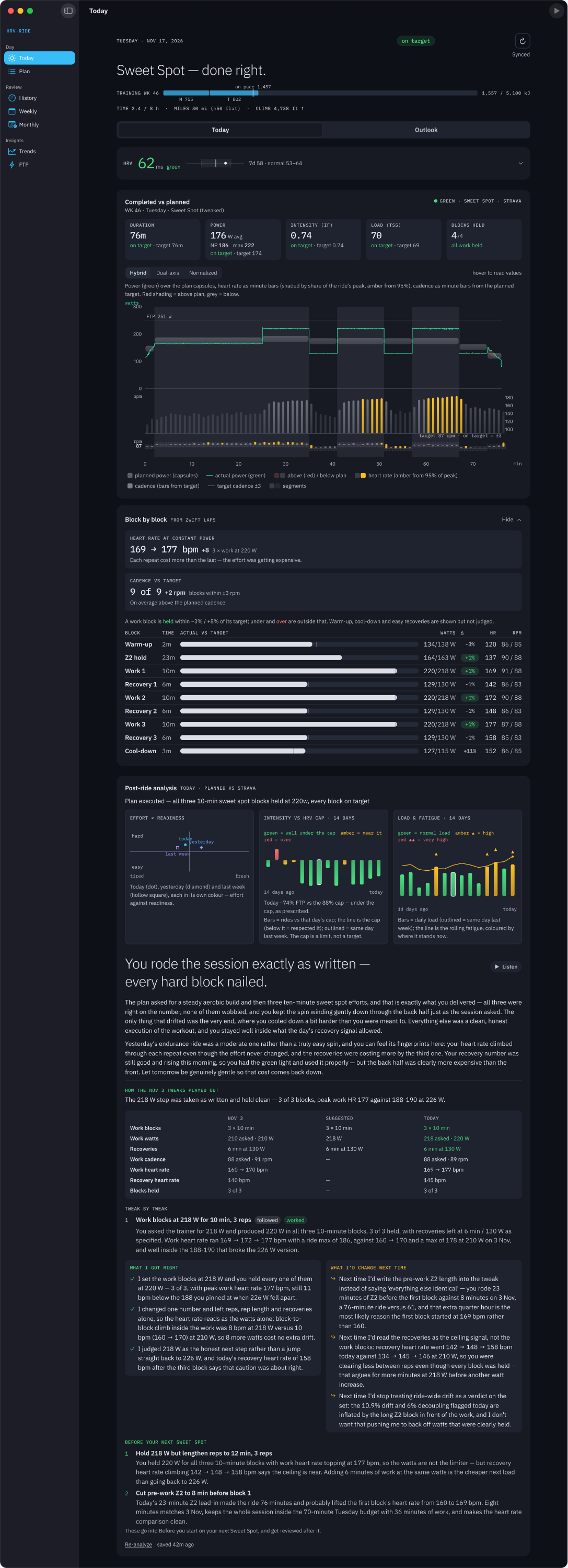
The biggest fix came in October, when I had the AI review the whole year. My plan asked for hard rides Tuesday through Sunday, and my HRV had allowed that 9 times in 50 rides. My FTP had been flat since August. The only stretch where I got better was when I did about three hard rides a week. So I rebuilt the week around three hard days with an easy day on either side: Sweet Spot on Tuesday, RUTT on Thursday and Long Tempo on Saturday. The goal changed from miles to 5,100 kJ, with my riding kept to roughly 8 hours a week.
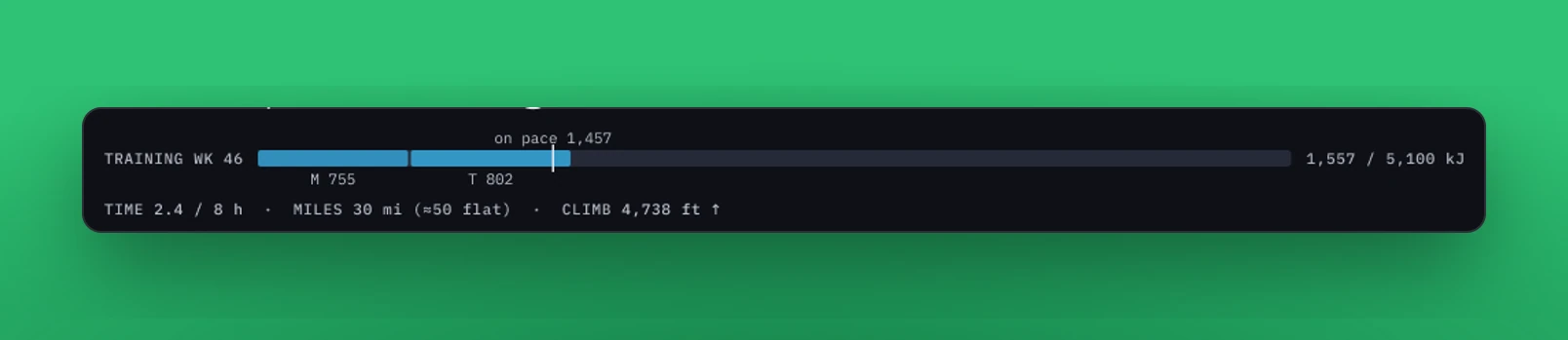
The results so far: I'm much more in the green than I was, and when I'm in the red, the app's next-ride recommendations are more likely to get me back to green. My FTP has held steady. At first that surprised me, but I've come to see it as my body regulating instead of burning the engine.
In short
That's what HRV Ride is all about: creating custom rides based on my fitness for that specific day, using today's metrics and my history.